Tuesday, October 24, 2006
Friday, October 20, 2006
planning the intervention - a few idea's
After a short while browsing youtube.com, aimlessly searching for ... Well, anything really. It struck me that maybe a movie would be a good way to reach people en masse. Obviously promotion of the movie would be part of the intervention. Perhaps posters, postcards or simple flyers would do the trick. There are obvious pro's and con's to each of these...
posters - where would I stick them? Would they get ripped down? I'd also have to research whether or not I'd get a fine from some stroppy council worker for 'littering'. On the plus, it's an obvious way to promote the film. It's within easy reach. I like this idea generally because making a film and 'marketing' it is familiar to me having been involved with a couple of short films before.
Postcards/Flyers - Standing on the street shoving these things into people's hands probably won't be one of the most exciting afternoons I'll ever have in my life but again, it's a good way to reach people. However, if the recipients are anything like me they won't even look at it and will stick it in the nearest bin. So here's where the idea of postcards come in. We all like to receive postcards from foreign places, buy them to remember a visit or simply send them from exotic places to make people jealous. We tend to keep them for a while until we have a spring clean/feng shui attack/de-cluttering of various odd's and sod's that most people (if not all) are guilty of collecting. BUT, most of us do keep them. They are thicker/heavier than paper. I would psychanalyse why people tend to keep postcards than flyers but I'll leave that to the psychology students. I will admit that if this is the route I go down then there is a large chance that I will be proved wrong if indeed they end up in the bin after 5 paces.
I could even do a mixture of both, bribe some of those miserable looking people who hand out the free papers (I say 'hand' but really mean 'smack them in the face with it'), or even horror-of-horrors, stand for hours in the cold handing leaflets out or fly-posting myself.
But the movie idea is the most appealing to me. Putting it on youtube.com and promoting the address is a good way to (hopefully) get people talking or at the very least form an opinion on what is happening to the local area. My aim isn't to persuade anyone into an opinion (I'll leave that to Rupert Murdoch), but rather get them thinking. The viewers will hopefully start thinking and questioning, forming opinions themselves maybe even taking action. I'm not sure if I fufill the brief that way. To me it's more appealing to ignite a spark (so to speak) among people's minds. The dictionary definition of Intervention is to modify/hinder or settle, I'm not 100% sure I'm fufilling that particular term.
However, on youtube there is a way of leaving comments so hopefully I'll get at least one form of feedback. Obviously I can't make people comment but if I get at a minimum of one then at least I would have fufilled the brief in some shape or form.
posters - where would I stick them? Would they get ripped down? I'd also have to research whether or not I'd get a fine from some stroppy council worker for 'littering'. On the plus, it's an obvious way to promote the film. It's within easy reach. I like this idea generally because making a film and 'marketing' it is familiar to me having been involved with a couple of short films before.
Postcards/Flyers - Standing on the street shoving these things into people's hands probably won't be one of the most exciting afternoons I'll ever have in my life but again, it's a good way to reach people. However, if the recipients are anything like me they won't even look at it and will stick it in the nearest bin. So here's where the idea of postcards come in. We all like to receive postcards from foreign places, buy them to remember a visit or simply send them from exotic places to make people jealous. We tend to keep them for a while until we have a spring clean/feng shui attack/de-cluttering of various odd's and sod's that most people (if not all) are guilty of collecting. BUT, most of us do keep them. They are thicker/heavier than paper. I would psychanalyse why people tend to keep postcards than flyers but I'll leave that to the psychology students. I will admit that if this is the route I go down then there is a large chance that I will be proved wrong if indeed they end up in the bin after 5 paces.
I could even do a mixture of both, bribe some of those miserable looking people who hand out the free papers (I say 'hand' but really mean 'smack them in the face with it'), or even horror-of-horrors, stand for hours in the cold handing leaflets out or fly-posting myself.
But the movie idea is the most appealing to me. Putting it on youtube.com and promoting the address is a good way to (hopefully) get people talking or at the very least form an opinion on what is happening to the local area. My aim isn't to persuade anyone into an opinion (I'll leave that to Rupert Murdoch), but rather get them thinking. The viewers will hopefully start thinking and questioning, forming opinions themselves maybe even taking action. I'm not sure if I fufill the brief that way. To me it's more appealing to ignite a spark (so to speak) among people's minds. The dictionary definition of Intervention is to modify/hinder or settle, I'm not 100% sure I'm fufilling that particular term.
However, on youtube there is a way of leaving comments so hopefully I'll get at least one form of feedback. Obviously I can't make people comment but if I get at a minimum of one then at least I would have fufilled the brief in some shape or form.
Thursday, October 19, 2006
example
a good example of an 'intervention'?
see for yourself....
http://www.geocities.com/londondestruction/elephant.html
see for yourself....
http://www.geocities.com/londondestruction/elephant.html
Tuesday, October 17, 2006
Monday, October 16, 2006
E&C of the past


A dictionary definition of 'Intervene/Intervention'.....
"to occur or come between; to occur between two events, etc; to come in to modify, settle, or hinder some action, etc."
A Definition of 'Art Intervention'....
"An art intervention is an interaction with a previously existing artwork, audience or venue/space. It has the auspice of conceptual art and is commonly a form of performance art. It is associated with the Viennese Actionists, the Dada movement and Neo-Dadaists. It has also been made much use of by the Stuckists to affect perceptions of other artwork which they oppose, and as a protest against an existing intervention." taken from wikipedia.org
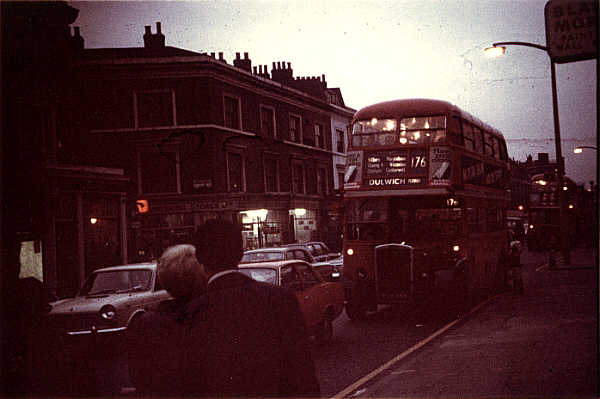
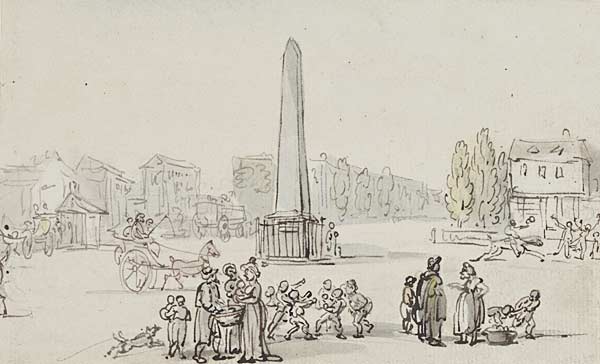
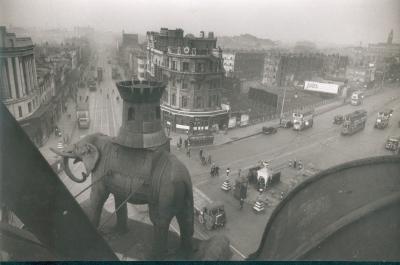
I've been looking at representations of Elephant & Castle from Victorian sketches to photographs of the local populace taking refuge in the tube station during the blitz.
During the second world war the area suffered extensive bombing damage. During the 1950's onwards up to the completion of the Heygate estate in the 1970's, E&C underwent a similar regeneration program that the powers-that-be plan for the area today.
Why I am looking at the past? Mainly due to the fact that my paternal family history stems from this very region. I take a keen interest in linking past buildings to stories that my father, grandmother and grandfather spoke of when I was a child. This is a kind of interaction between past and present, as I said earlier I am creating a link. I am not from this area. I was born in Buckinghamshire, always moving around greater London, but never living within it (until a few years ago). So this area seems familiar but strange and new at the same time. An interesting perspective perhaps?
Walking around the area, looking at the architecture... (call this sentimental trash if you will, I might actually be inclined to agree with you) I cannot help but think "my father must have played here as a boy" or "my grandmother must have walked down here" and wonder if they looked at the same building/path/road. Did they look but ever really see or notice? What did they think of it? Did they stand there and think the same as I am now albeit 50 years apart? I ask these questions but I know the answer. They (my paternal family) eventually left the area moving to Buckinghamshire in 1956 because of the crime (so they said). But I wonder, how many other families took the same path that my family did. Why did they leave? What did they think? Do people now have the same reasons and opinions that people had in the past? Do those opinions hold true to this very day?
If people hold the same views as they did then, what does that mean for Elephant and Castle? Does this much needed regeneration program have the ability to change the popular negative public opinion of the place (a large generalisation I am aware of)? Will the people who will live in E&C in ten, twenty, thirty years (when the novelty of the regeneration has worn off) view E&C the same way that many do now?
Elephant & Castle - where has it been? Where is it now and where is it going?
web address of E&C regeneration -
www.elephantandcastle.org.uk
Tuesday, October 03, 2006
Site specific Photographic Intervention


Some links about Photo specific intervention -
http://www.nps.gov/meve/planyourvisit/photography2.htm
http://www.contemporary-magazine.com/feature38_1.htm
http://www.photocircle.gr/ekdoseis/ekdoseis%20artha/eng_artha_3.htm
And one great site which provides insightful information on what a photo specific intervention is -
http://www.londonmet.ac.uk/architecture/courses/undergraduate/ba-spatial-arts.cfm
What constitutes spatial photographic practice?
From my understanding it includes everything within a space. In my case the proposed project it is Elephant & Castle in London. It could include architecture, people, social realism and street photography. Street photography itself covers a broad spectrum of everyday life - the good, bad, ugly, beautiful and interesting. It asks for engagement with the space and it's communities. Engagement/intervention to me means a 'study of' in photographic terms. Usually photography, especially street ( In my own opinion) means taking a passive stance. Observing the everyday and documenting it, without fully being involved (or 'engaged') with it. However, it does depend on what you are engaging with. People for example does need some form of communication between the photographer and subject, especially as some people do not like having their photograph taken. With regards to architecture, a passive observant aspect is the 'norm'.


.jpg)